How Much Tax Is Taken Out of a $1,000 Paycheck in Texas in 2026?
Paycheck explained · October 24, 2026 · 6 min read
The short answer
A $1,000 weekly paycheck in Texas in 2026 leaves you with $845.42. Tax takes $154.58, or about 15.5% of the check.
That number assumes you are single, paid weekly, and have no 401(k), health insurance, or other pre-tax deductions coming out of the check. Change any of those, and the check changes — the section on what can move your number, below, covers the usual reasons. The math itself, though, is straightforward, because Texas does not add a fourth tax line.
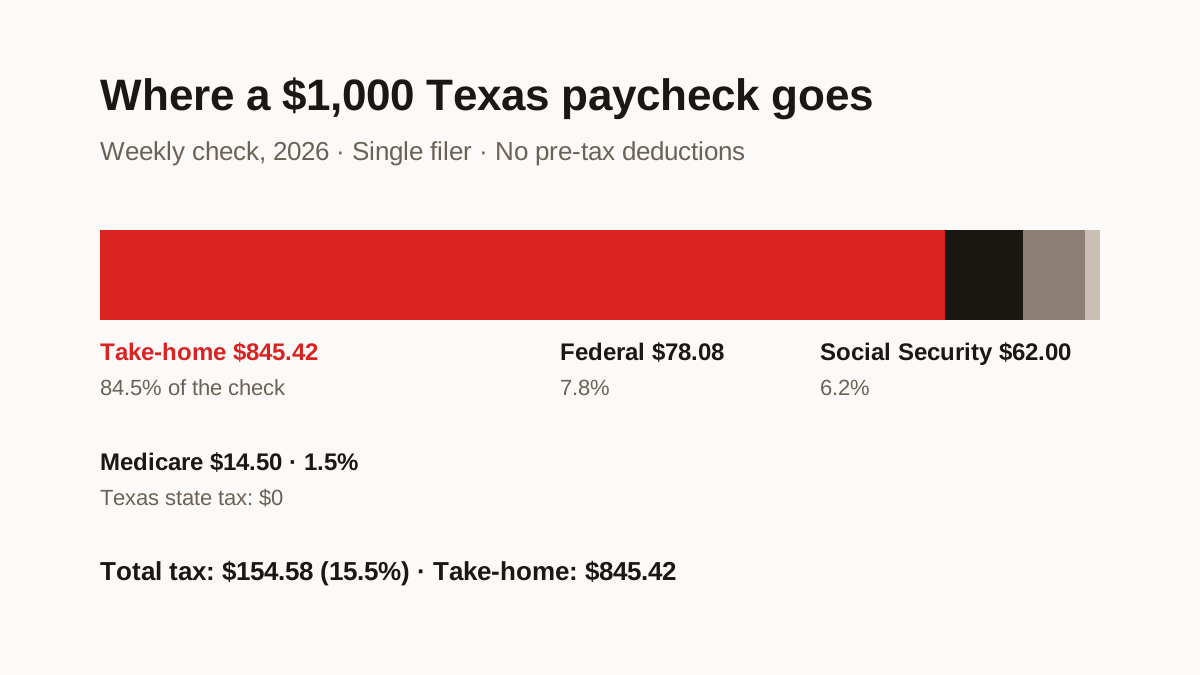
The full breakdown, line by line
On a $1,000 weekly check, your annual pay is $52,000. Payroll does not tax the $1,000 in isolation. It estimates your pay for the year, works out the tax on that annual figure, and then divides it back across your 52 checks. That is why the same $1,000 check can be taxed differently if you are paid every two weeks instead — more on that below.
| Deduction | Per paycheck | Per year |
|---|---|---|
| Federal income tax | $78.08 | $4,060 |
| Texas state income tax | $0 | $0 |
| Social Security (6.2%) | $62.00 | $3,224 |
| Medicare (1.45%) | $14.50 | $754 |
| Total tax | $154.58 | $8,038 |
| Take-home pay | $845.42 | $43,962 |
Why Texas takes $0
Texas has no personal income tax. That is not a deduction or a credit, it is simply absent: there is no Texas tax line on a Texas pay stub, and no Texas city adds its own income tax on top. If you moved the same $52,000 job to California or New York, a state line would appear and the take-home would fall. In Texas, the state line is $0, every check, at every income level in this example.
That does not mean Texas collects nothing from you. Sales tax, property tax, and other taxes still apply in daily life, but none of them come out of your paycheck. For a closer look at the state itself, see the Texas paycheck calculator, which runs the same 2026 figures for any salary.
How the $78.08 of federal tax is worked out
Start with $52,000, then subtract the 2026 standard deduction for a single filer, $16,100. That leaves $35,900 of taxable income. The tax brackets are marginal, which means each slice is taxed at its own rate, not your top rate on everything.
The first $12,400 of taxable income is taxed at 10%, which is $1,240. The next $23,500 — up to $35,900 — is taxed at 12%, which is $2,820. Add them together and you get $4,060 for the year, or $78.08 a week. Your marginal rate here is 12%, but your federal tax as a share of your full $52,000 is only about 7.8%, because the standard deduction and the 10% slice come first.
If you want to run a different salary, filing status, or pay schedule, the paycheck calculator uses these same brackets and the same standard deduction.
Social Security and Medicare: the fixed $76.50
These two are simpler, and they do not change with your filing status. Social Security takes 6.2% of the check, which is $62.00 on $1,000, up to $184,500 of wages for the year. Medicare takes 1.45%, which is $14.50, with no cap at all. Together they are 7.65%, or $76.50 on every $1,000 check, and your employer pays the same $76.50 on top — it just never shows on your stub.
At $52,000 a year you are well below the Social Security wage base, so the $62.00 does not stop during the year. The extra 0.9% Medicare tax only starts on wages above $200,000, so it does not touch a $1,000 weekly check at all.
The catch: $1,000 every two weeks is a different answer
This is where most $1,000-paycheck answers go wrong. A $1,000 check every two weeks is $26,000 a year, not $52,000, so payroll annualises a smaller income and withholds less federal tax. Social Security and Medicare stay at $76.50, because they are a flat percentage of the check itself, but the federal line falls.
| Pay schedule | Annual pay | Tax per check | Take-home per check |
|---|---|---|---|
| Weekly | $52,000 | $154.58 | $845.42 |
| Every two weeks | $26,000 | $114.58 | $885.42 |
On that biweekly $1,000 check, federal tax is $38.08, not $78.08, and the year's federal total is $990 instead of $4,060. Take-home for the year is $23,021 on $26,000 of pay, an effective rate of about 11.5%, against 15.5% on the weekly version. Same $1,000 on the stub, very different year — which is why the first question to ask about any paycheck number is always: how often?
What can make your real check different from $845.42
The $845.42 figure is the clean case. Real paychecks usually have at least one of these in play:
- Your W-4: extra withholding, a second job, or a spouse's income can all raise the federal line on a given check.
- Pre-tax deductions: a traditional 401(k) or health insurance premium lowers the income federal tax is worked out on, but it does not lower Social Security or Medicare, which are charged on your full wages.
- Overtime, bonuses, or a short week: a bigger check in one week is annualised as if you earned that amount all year, so that week's federal withholding can look high, then settle back.
- Benefits and garnishments: health, dental, HSA, and any court-ordered deduction come out after tax, so they shrink take-home without changing the tax lines above.
Check your own number
The fastest way to move past the $1,000 example is to put your own pay in. The paycheck calculator runs the same 2026 federal brackets, the Social Security wage base, and Medicare on any salary, hourly rate, filing status, and pay schedule, and the Texas paycheck calculator keeps the state line at $0 while you change the rest. If you are paid by the hour, the hours calculator can total the week first, before you run the tax numbers.
These figures are estimates, not tax advice. Your real stub can differ slightly with your W-4 choices, benefits, and any pre-tax deductions, but for a single filer in Texas with no pre-tax deductions, $845.42 on a $1,000 weekly check is the number to expect in 2026.
Questions, answered straight
How much tax is taken out of a $1,000 paycheck in Texas in 2026?
On a $1,000 weekly paycheck, $154.58 — $78.08 federal income tax, $62.00 Social Security, $14.50 Medicare, and $0 Texas state tax — leaving $845.42 take-home. This assumes a single filer with no pre-tax deductions.
Does Texas take state tax out of a paycheck?
No. Texas has no personal income tax, and no Texas city charges its own income tax, so the state line on a Texas pay stub is $0. You still pay federal income tax, Social Security, and Medicare.
Why are Social Security and Medicare $76.50 on a $1,000 check?
They are flat percentages: 6.2% Social Security ($62.00) plus 1.45% Medicare ($14.50) equals 7.65%, or $76.50. Social Security stops at $184,500 of wages for the year; Medicare has no cap.
Is tax on a $1,000 biweekly paycheck the same as a $1,000 weekly paycheck?
No. A $1,000 biweekly check is $26,000 a year, so federal tax is $38.08 and total tax is $114.58, leaving $885.42. A $1,000 weekly check is $52,000 a year, so total tax is $154.58 and take-home is $845.42.
Why is my actual $1,000 Texas paycheck not $845.42?
Your W-4, pre-tax 401(k) or health deductions, overtime, bonuses, benefits, and garnishments all change the check. Pre-tax deductions lower federal taxable income but not Social Security or Medicare. Run your own numbers in the paycheck calculator for your exact setup.
Sources
The figures in this post were checked against the official sources below. These links are for verification, not copied content.
- IRS — Revenue Procedure 2025-32, 2026 inflation adjustments — 2026 standard deduction and federal brackets.
- IRS — Topic No. 751, Social Security and Medicare withholding rates — 6.2% Social Security, 1.45% Medicare, and the 2026 wage base of $184,500.
- Social Security Administration — Contribution and Benefit Base — 2026 wage base of $184,500.
- Texas Comptroller — Texas has no personal income tax — Texas does not have a personal income tax.